Cost Comparisons for Plastics Manufacturing: Injection Molding vs. Thermoforming & Prototyping
When sourcing plastic parts, choosing the right manufacturing process is critical to balancing upfront tooling investments, unit costs, and structural performance. Different production volumes, geometric complexities, and mechanical requirements dictate distinct processing methods.
Below is a technical comparison of the three most common plastic manufacturing techniques, focusing on production costs, tooling requirements, and application suitability.
1. Plastic Injection Molding
Process Overview:
Injection molding is the gold standard for high-volume plastic production. The process involves plasticizing thermoplastic or thermosetting polymer pellets inside a heated barrel using a reciprocating screw. The molten polymer is then injected into a precision-machining steel or aluminum injection mold cavity under high pressure. Once cooled and solidified, the part is ejected.
This method accommodates complex geometries, tight tolerances, and integrated features (such as bosses, ribs, and snap-fits), while supporting high-speed automation and diverse color/texture options.
Tooling & Cost Structure:
- Upfront Tooling Cost: High. Custom injection molds require significant capital investment for precision CNC machining, EDM, and fitting.
- Unit Cost: Exceptionally low at scale. Once the mold is qualified, the per-part cost drops dramatically, making it the most cost-effective solution for medium-to-high volume production.
- Secondary Operations: Minimal, as parts emerge with near-net shapes and finished surfaces.
2. Rapid Prototyping (Low-Volume Validation)
Process Overview:
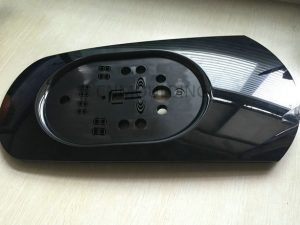
Before committing to full-scale production tooling, rapid prototyping is utilized to validate design intent, form, fit, and function. While technologies like CNC machining, SLA, and SLS 3D printing dominate early-stage prototyping, rapid tooling (such as soft-tooling aluminum molds) can also produce small batches of functional injection-molded parts using production-intent resins.
Tooling & Cost Structure:
- Upfront Tooling Cost: Low to moderate (often utilizing simplified or bridge molds).
- Unit Cost: High per part compared to mass production.
- Application: Ideal for design verification, functional testing, and low-volume bridge production before investing in hardened production molds.
3. Thermoforming
Process Overview:
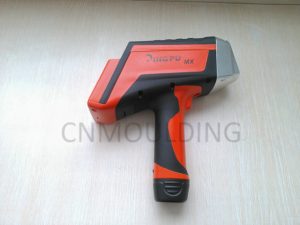
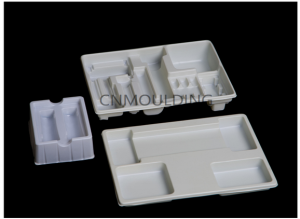
Thermoforming involves heating a thermoplastic sheet (such as ABS, PVC, PETG, or Polycarbonate) until it becomes pliable. The sheet is then stretched over or into a single-surface mold using vacuum, pneumatic pressure, or mechanical force. After cooling, excess material is trimmed away.
Common applications include large automotive trim panels, enclosures, packaging trays, and housings with relatively uniform wall thickness.
Tooling & Cost Structure:
- Upfront Tooling Cost: Low. Thermoforming uses single-surface molds (often made of wood, epoxy, or cast aluminum), which are much simpler and cheaper than multi-cavity injection molds.
- Unit Cost: Moderate. Suitable for low-to-medium volume production, especially for large-surface-area parts where injection molding tooling would be cost-prohibitive.
- Design Limitations: Restricted to parts with uniform wall thickness, draft angles, and simpler geometric features compared to injection molding.
Summary Cost Comparison: Which Process Should You Choose?
- Choose Plastic Injection Molding when your project requires high dimensional accuracy, complex structural details, and high-volume production. Although initial injection mold tooling requires a higher upfront budget, it delivers the lowest total cost of ownership over the product lifecycle.
- Choose Thermoforming when developing large-scale parts (e.g., large housings or trays) with moderate geometric complexity in low-to-medium quantities, where minimizing tooling investment is the priority.
- Choose Rapid Prototyping in the initial product development phase to test engineering concepts before authorizing full-scale production tooling.
Need a detailed cost breakdown or DFM (Design for Manufacturability) analysis for your upcoming project? Contact our engineering team to get a professional quote.
.