

Sourcing from China: How to Choose the Right Size Injection Mold Manufacturer
If you search for the “Top 10 Mold Manufacturers in China,” you will likely see a list of massive, state-owned or highly subsidized conglomerates. Yet, for most global OEMs and product developers, these names are completely unrecognizable. These vanity rankings are based on macro-volume (like heavy automotive stamping dies) rather than the high-precision, flexible, and export-compliant tooling that overseas buyers actually need.
With tens of thousands of tool shops in China, filtering the noise requires a strategic approach. Sourcing shouldn’t just be about finding the “biggest” factory, but about finding the perfect fit for your tooling complexity and order volume.
Here is a realistic look at how factory scale affects your project—and why chasing scale can backfire.
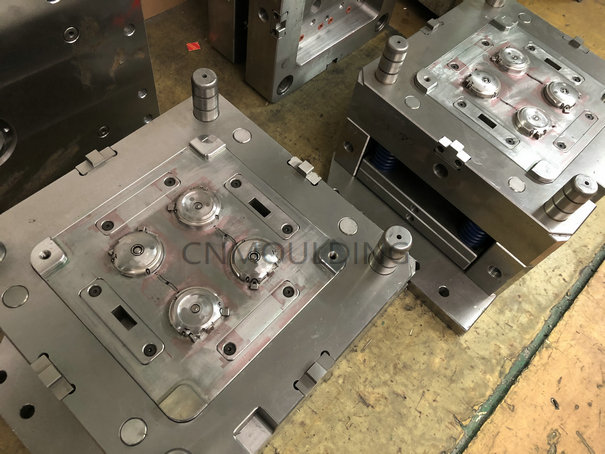
The Scale Dilemma: Large vs. Small-and-Medium Tool Shops
1. The Pitfalls of Large-Scale Tool Shops
On paper, mega-factories look perfect: massive facilities, hundreds of employees, and endless financial backing. However, for mid-sized or specialized projects, they present severe operational hurdles:
- Prohibitive Overhead Costs: Large factories come with massive management layers. These internal costs are passed directly to you, making their tooling quotes excessively high—often exceeding your target budget.
- The “Low-Priority” Neglect: If your project isn’t a multi-million-dollar account, you will not get their attention. Your project gets pushed to the back of the queue, resulting in slow communication and rigid, delayed responses when design changes are needed.
- Lack of Accountability: When a large shop treats you as a low-priority client, quality control and delivery dates for your tools often slip because their primary focus remains on their top-tier domestic accounts.
2. The Danger of Small, Under-Equipped Shops
To avoid high prices, many buyers pivot to small-scale shops. While their initial pricing is attractive, you quickly face critical risks regarding lead times, tool life, and mass-production stability.
The root cause of these failures is outsource dependency (Outsourcing Process Parts). If a tool shop does not own a complete, in-house ecosystem of precision machinery, they are forced to farm out critical operations (like core/cavity cutting or fine EDM) to third-party workshops.
The True Cost of Outsourced Toolmaking
When a mold factory outsources machining processes, it triggers three severe consequences for your project:
1. Escalate Tooling Costs
Every time a workpiece leaves the factory floor to an external vendor, an additional profit margin is tacked on. A shop that relies heavily on outsourcing cannot control its baseline manufacturing costs, which ultimately inflates your final invoice or introduces hidden fees during tool optimization (T1 to T2 trials).
2. Extended Lead Times & Communication Lag
Toolmaking requires continuous, iterative adjustments. Moving workpieces back and forth between the primary mold shop and tiny, external machine shops creates massive logistics delays. Even if your contract includes late-delivery penalties, a financial fine cannot recover lost time-to-market or missed product launch windows.
3. Complete Loss of Quality Control (The Highest Risk)
This is the most critical threat to your project. When a tool shop outsources, they lose the ability to monitor manufacturing quality in real-time.
External vendors are often small, unstructured machine shops utilizing second-hand equipment and aggressive, uncalibrated machining parameters. To fix errors quickly, they frequently resort to brute-force methods like structural welding or excessive manual grinding.
- The result? The mold arrives looking acceptable on the outside, but the internal steel steel suffers from induced thermal stress, micro-cracking, and structural distortion.
- The consequence: The tool fails prematurely, flashes excessively during production, and fails to achieve its rated shot-life cycle. In worst-case scenarios, the mold is entirely unviable for automated mass production.
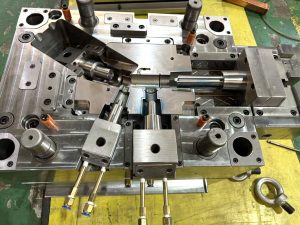
The Sweet Spot: Engineering-Driven, Medium-Scale Precision Shops
To secure export-quality molds at a competitive price point, savvy procurement managers target highly specialized, mid-sized precision toolmakers that maintain 100% in-house manufacturing capabilities.
At this scale, you become a high-priority partner, ensuring dedicated engineering attention while maintaining strict quality control. Before signing a tooling contract, verify that the facility owns and operates the following essential equipment under one roof:
- High-Speed CNC Machining Centers: For precise, automated milling of complex core and cavity geometries.
- Wire-Cutting EDM (Sodick/Fanuc or equivalent): Crucial for sub-micron accuracy on tight-tolerance sliders, lifters, and interlocking features.
- Mirror EDM Spark Machines: Essential for burning deep, intricate ribs and achieving pristine surface finishes without relying on heavy manual benching.
- In-House Injection Molding Equipment: For rigorous T1-Tn mold trials, allowing engineering teams to optimize parameters and validate tool performance in real-time.
- CMM Inspection Labs: Controlled-environment coordinate measuring machines to verify final component dimensions against your initial 3D CAD models.
Partner with CNMOULDING in Shanghai
At CNMOULDING, we have positioned our Shanghai facility to be the ideal mid-sized manufacturing partner for global businesses. Founded in 1997, we combine the technical rigor, machinery infrastructure, and ISO-certified management of a large enterprise with the agility, cost-efficiency, and responsive communication of a dedicated engineering partner.
We do not outsource our critical processes. From initial DFM engineering and moldflow analysis to final CNC cutting, mirror EDM, and T1 tool validation, everything is controlled under our roof to maintain strict ±0.005mm tolerances.
Skip the corporate bureaucracy of mega-factories and the quality risks of under-equipped workshops. Contact our engineering team today to review your project.