When manufacturing high-precision plastic components for international life science OEMs, maintaining strict micron-level tolerances is only half the battle. The other half is ensuring complete alignment on metrology and inspection methods between the supplier and the client.
A common but critical pitfall in medical injection molding is dimensional deviation caused by utilizing conflicting inspection tools. Here, CNMOULDING shares a real-world case study on how we resolved a 0.1 mm inner diameter measurement dispute on a sharp-edged medical device component.
The Problem: A $0.1\text{ mm}$ Inspection Discrepancy
During a recent production run for an international client, initial quality audits revealed a critical dimensional deviation on a cylindrical fluid-path medical component:
- Client’s Required Specification: varnothing 2.44 mm
- Initial Internal Tooling Measurement: varnothing 2.54 mm
While a $0.1\text{ mm}$ variance might initially suggest a wrong injection mold cavity dimension, our engineering team conducted a deep-dive root cause analysis. We discovered the mold steel was cut perfectly to specification; the discrepancy was entirely artificial, caused by a mismatch in measuring methodology.
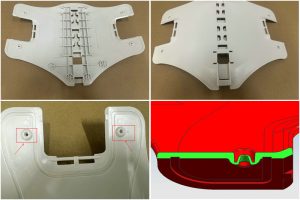
[ False Measurement ] ──> Traditional Caliper ──> High Clamping Force ──> Part Deformed ──> Reads 2.54 mm
[ True Measurement ] ──> Custom Pin Gauge ──> Zero Clamping Stress ──> No Deformation ──> Reads 2.44 mm
Technical Analysis: Why Calipers Fail on Sharp-Edged Medical Plastics
The component in question featured a highly sensitive, sharp-edged internal hole. Through repetitive measurement verification, our Metrology Lab proved that traditional digital calipers are entirely unsuitable for this geometry:
- Material Elasticity & Clamping Force: Plastic is inherently elastic. When an operator applies even slightly excessive manual force with caliper jaws, the sharp plastic edge flexes slightly, artificially inflating or deflating the perceived bore diameter.
- Point Contact vs. Surface Contact: Calipers rely on cross-point contact, which can easily slip on sharp or tapered internal lips, leading to inconsistent measurement outputs across different QA operators.
The Solution: Transitioning to Standardized Pin Gauge Inspection
To eliminate human error and tool-induced deviations, CNMOULDING implemented a specialized testing protocol specifically tailored to the unique structural design of this medical part:
- Implementation of Go/No-Go Pin Gauges: We replaced calipers with high-precision, customized pin gauges (plug gauges). A pin gauge makes uniform surface contact with the hole’s inner wall without applying local structural stress, completely eliminating part deformation.
- Standardizing Quality Control Protocols: We established a standardized Measurement System Analysis (MSA) and calibrated the identical gauge sets to be used both at our Shanghai-adjacent factory and the client’s incoming inspection facility.
- IQ/OQ/PQ Validation Support: All calibrated inspection workflows were fully integrated into our ISO 13485 quality management framework, ensuring full lot traceability and dimensional repeatability across millions of operational injection molding cycles.
Conclusion & Global Healthcare Standards
For specialized medical components, standard tools are often not enough. By proactively identifying tool variations, utilizing specialized metrology, and locking in strict quality controls, CNMOULDING ensures that all exported medical parts align perfectly with global quality standards.
Align Your Medical Metrology with an Expert Toolmaker
Avoid costly measurement disputes and shipping delays. Partner with a technically sound China mold maker who understands scientific molding and inspection alignment.
Contact CNMOULDING today via cnmoulding.com for a free DFM and engineering consultation.