
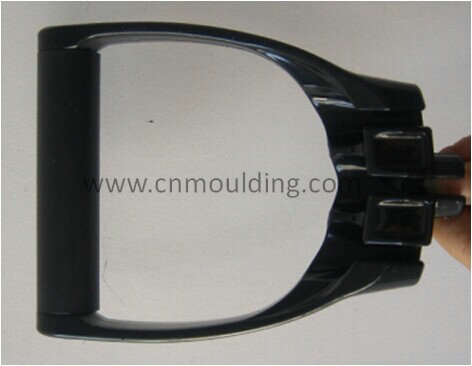
Custom Plastic Bar Handle & Fitness Equipment Component Manufacturing
Are you looking for a reliable manufacturing partner for high-strength plastic bar handles and fitness equipment components?
At CNMOULDING, based in Shanghai, we bring extensive specialized experience to the engineering, tooling, and mass production of plastic handles and structural bars for the global sports and fitness industry. By combining advanced injection mold design with precision ultrasonic welding techniques, we deliver premium, high-durability components that meet the rigorous safety and ergonomic standards of international markets.
Technical Specification & Production Solution: Injection Molded Plastic Bar Handles
This technical document outlines the manufacturing specifications, tooling requirements, and process engineering for high-strength plastic bar handles and structural crossbars utilized in the fitness equipment industry.
At CNMOULDING, we engineer these components to withstand continuous cyclic loading, ensuring zero structural failure and high dimensional repeatability for high-volume production runs.
1. Commercial & Production Overview
- Part Name: Plastic Bar Handle / Structural Grip Crossbar
- Target Unit Price: $2.00 USD / Set (Based on standard material specifications)
- Production Capacity: 100,000 Sets (100K)
- Tooling & Production Lead Time: Within 30 days from DFM approval
2. Technical Challenges & Engineering Solutions
Plastic handles and bars used in fitness equipment face severe operational stresses. Below are the primary engineering challenges we solve during injection mold design and production:
Challenge A: Balancing High Mechanical Strength with Defect-Free Surface Finishes
- The Problem: Thick-walled plastic handles are highly prone to internal volumetric shrinkage, vacuum voids, and surface sink marks. These defects drastically compromise the structural load capacity and haptics of the handle.
- Our Solution: We avoid excessively thick solid cross-sections by designing a hollow or internally ribbed structural configuration. If a solid structure is mandatory, we utilize specialized engineering resins (e.g., Glass-Filled Nylon PA66+GF, or high-impact ABS/PC blends) and execute a scientific molding process with elevated pack-and-hold pressures and optimized cooling cycles to ensure uniform density.
Challenge B: Ensuring Unbreakable Joints in Multi-Piece Assemblies
- The Problem: Hollow handles or those requiring internal metal inserts must be molded in sections and assembled. Traditional mechanical snapping or chemical gluing fails under long-term torsional and tensile stresses.
- Our Solution: Ultrasonic Welding Integration. We mold the handle in precision-matched half-shells with a pre-engineered energy director joint line. Post-molding, these components undergo automated ultrasonic welding. The high-frequency acoustic vibrations melt the contact interface locally, creating a continuous, homogenous molecular bond that matches the tensile strength of the base resin.
3. Tooling Design & Machining Standards
To ensure tool life exceeds 500,000 cycles for high-volume 100K batch orders, our toolroom enforces strict machining parameters:
- Mold Base & Steel Selection: We utilize standard LKM, HASCO, or DME mold bases. For abrasive glass-filled materials, cavity and core inserts are machined from hardened H13 or S136 tool steel (Hardness: HRC 48–52) to resist wear and prevent flash.
- Gating System: Optimized valve gate hot runner systems or balanced cold runners are deployed based on cost constraints. Gates are strategically positioned at non-functional surfaces to minimize cosmetic shear marks and weld lines near high-stress zones.
- Ejection & Venting: Balanced ejector pin layouts prevent part warping during stripping. Deep perimeter venting slots ($0.015\text{mm}$ to $0.025\text{mm}$ depth depending on material) are integrated to prevent gas burns and air entrapment.
4. Quality Control & Process Stability
Our manufacturing cell utilizes closed-loop servo-driven injection molding machines to lock in critical process parameters:
- Real-Time Monitoring: Injection speed profiles, cavity pressure curves, and dosing positions are monitored via linear scales to ensure shot-to-shot consistency.
- Post-Welding Inspection: Welded bar handles undergo destructive torque testing and pull-force sampling tests to verify that the joint line meets the specified Newton-meter (N·m) load requirements before packaging.
- Dimensional Verification: Critical tolerances are audited using Coordinate Measuring Machines (CMM) and digital calipers against the approved 2D/3D CAD models.
5. Request for Quote (RFQ) Requirements
To initiate a formal technical and financial review for your plastic bar handle project, please provide the following data to our engineering department:
- Complete 3D CAD models (STEP/IGES format) and detailed 2D drawings indicating critical tolerances.
- Specified resin grade (or environmental requirements such as UV resistance, flame retardancy, or soft-touch overmolding requirements).
- Estimated annual usage (EAU) and packaging requirements.