
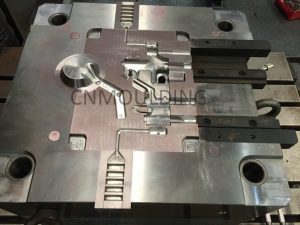
Comprehensive Guide to Precision Die Casting: Process, Capabilities & Applications
Die casting is an advanced high-pressure metal casting process that forces molten non-ferrous alloys into a reusable hardened tool-steel mold (die) at extreme velocity. It is the gold standard for producing high-volume, thin-walled, and structurally complex metal components with minimal machining requirements.
Key Features of Die Casting
- High-Pressure & High-Speed Injection: Molten metal is injected at speeds up to 100 m/s and pressures reaching up to 1,000+ bar.
- Reusable Hardened Tooling (Dies): Tooling fabricated from premium steel (e.g., H13) capable of withstanding tens to hundreds of thousands of production cycles.
- Exceptional Precision & Surface Finish: Achieves tight geometric tolerances and smooth surface textures, drastically reducing or eliminating post-machining.
- Lightweight Thin-Walled Structures: Capable of forming ultra-thin, high-rigidity structural walls (down to 1.0–1.5 mm).
Common Alloys & Material Selection
- Aluminum (Al): Ultra-lightweight with excellent dimensional stability, thermal management, and corrosion resistance. (e.g., A380, ADC12)
- Zinc (Zn): High impact strength, superior ductility, and ideal for intricate, high-precision small parts with thin walls. (e.g., Zamak series)
- Magnesium (Mg): The lightest structural metal available, delivering high strength-to-weight ratios for aerospace and portable electronics.
- Copper & Brass: Exceptional electrical and thermal conductivity, though requiring higher melt-temperature tooling setups.
Core Process Variations
1. Hot-Chamber Die Casting
- Target Materials: Low-melting-point alloys (Zinc, Lead, Tin).
- Mechanism: The injection mechanism is directly submerged in the liquid metal bath, enabling ultra-fast continuous cycle times.
2. Cold-Chamber Die Casting
- Target Materials: High-melting-point alloys (Aluminum, Magnesium, Copper).
- Mechanism: Molten metal is ladled manually or automatically into an unheated shot sleeve before high-pressure plunger injection.
Advantages vs. Limitations
Key Advantages
- High volumetric throughput and structural repeatability.
- Superior mechanical strength compared to plastic injection moldings.
- Tight dimensional tolerances ($\pm0.1 \text{ mm}$ or better).
- Excellent integration of mounting bosses, heat sinks, and structural ribs.
Process Limitations
- Significant upfront tooling investment (unsuitable for low-volume prototyping).
- Primarily limited to non-ferrous metals and alloys.
- Risk of internal porosity in thick-walled sections without vacuum-assisted injection.
Process Comparison: Die Casting vs. Alternative Methods
| Feature | Die Casting (HPDC) | Sand Casting | Investment Casting | Plastic Injection Molding |
|---|---|---|---|---|
| Surface Finish | Excellent (Ra\ 1.6 – 3.2\ \mu\m) | Rough | Very Good | Outstanding |
| Dimensional Tolerance | Very High (pm0.1 mm) | Low | High | Very High |
| Production Speed | Fast (30-100\ shots/hr) | Slow | Moderate | Very Fast |
| High-Volume Unit Cost | Low | Low | High | Very Low |
| Material Types | Non-Ferrous Metals | All Ferrous/Non-Ferrous | All Ferrous/Non-Ferrous | Thermoplastics |
Key Industrial Applications
- Automotive & EV Systems: Motor housings, transmission cases, battery tray frames, and structural brackets.
- Aerospace & UAVs: High-rigidity drone chassis, heat dissipators, and sensor enclosures.
- Electronics & Telecom: 5G base station radiator fins, LED housings, and optical enclosures.
- Medical Equipment: Lightweight structural frames for diagnostic imaging tools and surgical devices.