
Which Plastic Manufacturing Process is Right for You?
When it comes to manufacturing plastic parts, Injection Molding and Thermoforming are two of the most popular and efficient methods used in the industry. While both processes create high-quality plastic components, they rely on completely different technologies, equipment, and material starting points.
Understanding the differences between them is crucial for choosing the most cost-effective and efficient solution for your project.
1. Plastic Injection Molding: Precision and High Volume
The Injection Molding Process
Plastic injection molding is a highly precise process designed for high-volume production.
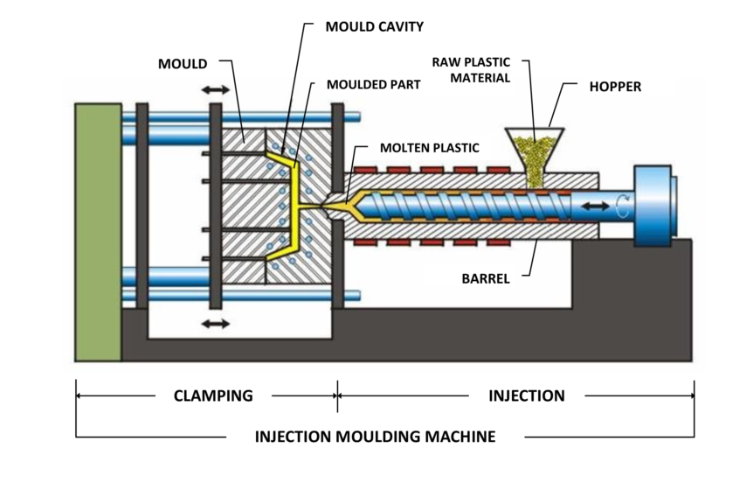
- Melting: Thermoplastic raw material (in pellet form) is fed into a heating barrel, where it is melted into a liquid polymer.
- Injection: The molten plastic is injected into a custom-machined steel or aluminum mold cavity at high temperature and extreme pressure.
- Cooling & Ejection: Once the plastic fills the mold, it is quickly cooled until it solidifies. The mold opens, and the finished part is ejected.
One of the greatest advantages of injection molding is that the resulting shape is often the final product. Complex details such as bosses, ribs, internal threads, and intricate geometries can be molded in a single step, requiring no secondary trimming or processing.
Understanding Injection Molding Machinery
An injection molding machine consists of two primary components: the injection unit (for melting and injecting the plastic) and the clamping unit (for holding the mold shut under immense pressure).
There are two main types of injection mechanisms used today:
- Reciprocating Screws: The most common and cost-effective system, where a single screw melts, mixes, and injects the plastic without needing an extra plunger.
- Screw Pre-plasticizers (Two-Stage Devices): This system uses a dedicated screw to melt the plastic (stage one) and a separate injection rod to shoot it into the mold (stage two).
- Advantages: Constant melt quality, high pressure, high speed, and precise shot volume control—ideal for transparent, thin-walled products and ultra-high production rates.
- Disadvantages: Higher equipment and maintenance costs, and non-uniform residence times which can lead to material degradation if not managed carefully.
2. Thermoforming: Versatility and Rapid Tooling
The Thermoforming Process
Unlike injection molding, which starts with plastic pellets, thermoforming starts with a pre-extruded plastic sheet.
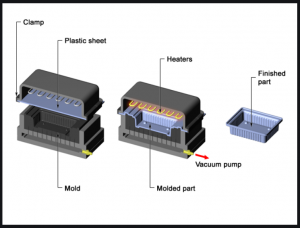
- Clamping & Heating: A single sheet of plastic is securely clamped in the machine and heated until it becomes soft and pliable.
- Forming: The softened sheet is draped over a mold surface. Molds can be either positive/male (the plastic forms over the exterior) or negative/female (the plastic is drawn into the interior).
- Vacuum Adsorption: A vacuum (often assisted by pressure) draws the plastic sheet tightly against the mold contours.
- Cooling & Trimming: Water channels running through the mold assist in rapid cooling. Once solidified, the part is removed and trimmed to remove excess scrap material before shipment.
Application: Thermoforming Packaging
Thermoforming is widely utilized in lighting, advertising, decoration, and especially the plastic packaging industry (commonly known as blister packaging). Typical products include blisters, trays, plastic clamshells, and vacuum hoods.
Key Advantages of Thermoformed Packaging:
- Material Efficiency & Lightweight: Saves raw and auxiliary materials, reducing overall product weight and transport costs.
- Excellent Sealing: Meets modern green and eco-friendly packaging requirements with great sealing performance.
- Custom Protection: It can form around complex, irregular, or special-shaped products without requiring extra internal cushioning.
- High Visual Appeal: Beautiful aesthetics that enhance shelf appeal, making it perfect for mechanized, automated packaging and modern logistics management.
Common thermoforming packaging types include slide card blisters, heat-seal blisters, double/half clamshells, and folding blisters. The equipment used typically involves plastic forming machines, die-cutting presses, sealing machines, and high-frequency welding machines.
Summary: Key Differences at a Glance
| Feature | Plastic Injection Molding | Thermoforming |
| Starting Material | Plastic Pellets (Granules) | Extruded Plastic Sheets |
| Tooling Cost | High (Steel/Aluminum CNC Molds) | Low to Medium (Composite/Aluminum Molds) |
| Lead Time | Longer (due to complex mold making) | Shorter (faster prototyping and tooling) |
| Part Complexity | Highly complex, handles internal threads & ribs | Simple to moderately complex, consistent wall thickness |
| Production Volume | Ideal for high-volume mass production | Ideal for low-to-medium volumes or large packaging runs |
| Secondary Processes | Rarely needed (parts are finished upon ejection) | Trimming is required to remove excess sheet scrap |
Need Professional Advice for Your Next Project?
Choosing between thermoforming and injection molding depends on your part design, budget, production volume, and timeline.
At www.chinamoldmaker.org, we specialize in high-quality mold manufacturing and plastic processing solutions. Contact our engineering team today to get a professional evaluation and a competitive quote for your next project!